Mercy Girl: 40 Years Later

14 Oct

photoI survived my 40th high school reunion yesterday without embarrassing myself too much or giving in to the group surge of “Let’s only talk about funny-fun stuff we did!”  It was the very first invitation I had received from the school where I spent three anxious years during pretty much the worst years of my life.

I arrived as a sophomore, which was rare for a class that had bonded as little girls at Catholic grammar schools spread out all over San Francisco.

While I was away at summer camp, My Toxic Mom had thrown out all my clothes hanging in my closet, replacing them with two red-white-and-blue plaid skirts, four white Peter Pan collar style shirts, a few pairs of knee socks and one scratchy wool sweater. That’s how I knew she had enrolled me at Mercy.

Immediately exempted from attending chapel or other religious events, I was told to read in the library. And because no one ever said I couldn’t, I started reading whatever I wanted. I would lay on the carpet several hours a day and read biographies mostly, searching for lives that mirrored mine in some way.

My home life was so chaotic and unbearable that I had trouble focusing on any organized study effort. I had no understanding of cycles of a school year, that study led to quizzes and semesters meant finals. Every day was a distinct event, unconnected to the previous day or creating a path to other days. Quite frankly, because I was living in a terror-driven home, each morning I arrived at school I took a deep breath of relief that I had survived the night.

I was that kid that sat in the back, looking out the window. My low grades reflecting my state of mind. I can see how some teachers could write me off.

I had very few friends then, none of which I had kept up with. So, imagine my surprise when a woman sidled up to me like a former con I had served time with. She spoke out of the side of her mouth, telling me quickly who else might show and that she had saved some seats for us — in the back.

We were all wearing name tags with our enlarged senior photos. While we bought drinks to get through the lunch I stared at hers. I knew who she was, but didn’t really remember her very well. But she remembered me. At one point she said that she always thought that I had a hard time in school.

“Well, yah. But I had a terrible home life. I really wish I had embraced school more, but I just wasn’t able to. All the girls seemed so connected and I wasn’t part of that,” I said with a smile.

“I think you alluded to your home life once, but I had no idea it was really that rough,” she said.

“Well, kids get through it because they have no perspective. They have nothing to compare it to. It’s a blessing really,” I replied.

We kept talking about our lives now and the things that we’re passionate about and we ran into a couple of other girls who used to be part of the little group of misfits that sat on the lawn to smoke and trade stories about boys and bands and stealing our parents cars. Two of our group had babies early. I realized while we were talking that most of the girls I knew then were outsiders, one way or the other.  They had a common history of showing up randomly, looking lost, being brought into the circle, and then either leaving school suddenly, or drifting off like I did. I had forgotten that we’d flirted with guys in motorcycle gangs, that we used to hitchhike in our uniforms, that we rolled our skirts up so high the hems sat rigidly atop the seats of chairs.

All around us at the reunion, gaggles of women in groups of five or six or seven, linked their arms and bodies together and jumped up and down squealing with delight at simply being in each other’s company.  We sure didn’t. The noise and energy got to be too much for me so I walked down to the girls bathroom, the scene of so much former teen drama. The expression of reunion happiness was nauseating me.

I managed to get through a very nice chicken salad lunch with warm (cat-piss) chardonnay and a PowerPoint “in memoria” presentation of about a dozen girls in our class of 223 that have died. Then there was another show of snapshots of all the fun our class had at school plays, dances, and ski trips that I never attended. I wondered if I had been capable of signing up and showing up could I have changed my high school experience?  Out of the corner of my eye, I noticed a certain sister (not a sister anymore, I heard) who once told me that I should set my sights on a career in retail. She was sure I could get a job at The Emporium Dept. store.

I went to the bathroom again.
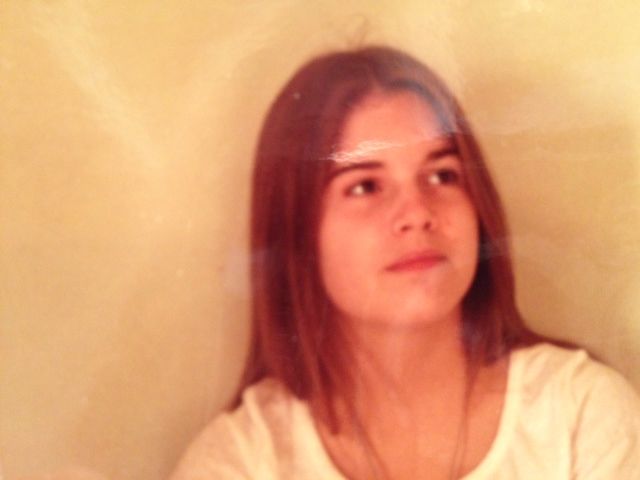
photoAs I stood there combing my hair I was composing the hallway speech I would give to the sister informing her of everything I had accomplished in my life despite never being helped or supported or even seen  in any way. It took me awhile, but I found my life path and had built a grand life — she needed to know.

The group photo was scheduled for a few minutes hence and several women were fixing their faces. One said she couldn’t take the NOISE in that room and I agreed. As she opened the door, she turned to ask me “Are you going back in?”

“I’m not really sure I can.” I said with a smile.

But I did head back to the assembly room just as everyone was heading out double doors to the front of the school to have a professional photograph taken on risers under the school banner.

I took a few steps to join the group but stopped short. I realized that nobody needed to hear my speech, least of all the person who had never really seen me in the first place.

“I can’t do this.” I said to myself. “And I don’t have to.”

It wasn’t until I was outside near my car that it suddenly hit me that, because of the way I had parked,  I literally had to drive past the entire class of 1973 posing in the blustery cold. Everybody – or nobody – would see me leaving and I didn’t much care.

I was meeting my husband in North Beach to listen to live jazz at the Savoy Tivoli. It was our anniversary and after dinner we’d go to see Sam Shepherd’s “Buried Child” at the Magic Theater. I had faced the past and that was enough. It was time to get back to the best years of my life.
Toxic Mom Toolkit goes to Petaluma Palooza

24 Sep

d253894499584171e7a4c825fd53a904I’m two weeks into the Amazon.com publishing process with an anticipated six weeks to go before my first book, “Toxic Mom Toolkit” will drop, so I figured, why not?  Why not go to my local expo, Petaluma Palooza, which invites everyone and anyone to set up a space and talk about what they are passionate about.

I started writing my book in 2010, after leaving my newspaper reporter job of nearly a decade. I wrote my book because I always said if there was a topic that I knew better than anyone else, I would have to write a book. Guess what? This is my topic. After surviving a toxic birth mother and toxic adoptive mother, I know a little bit about all sorts of Crazy Mom behaviors. I somehow managed to turn out (as Scout would say in To Kill a Mockingbird”) “PRETTY” normal. I was a mature, happy woman, with some free time and it was time to do it.

I had been told that you should also start a Facebook page when you start writing a book, to build your audience and let them watch how you do it. Which, in my case, included a lot of procrastinating, worrying and second-guessing. We started with 33 of my friends “Liking” Toxic Mom Toolkit, and, last time I checked, attract 250,000+ to the page EACH MONTH.

I was sick with nerves the night before and day of. How did I explain it to people? Real people from my town who might also see me in the market or the movies? How did I explain this mission without scaring them?

“Hi, I’m Rayne Wolfe,” I said. “I’m a Petaluma journalist and for the past three years I’ve been writing a book that will be published in six weeks. It’s called Toxic Mom Toolkit. It’s for adult children of SUPER toxic moms. It’s sort of a survival guide and part of a movement that’s moving out of the shadows.”

And then I smiled and held my breath. And here’s what people told me:

“That must have been very healing for you. Good for you. And good for helping other people.”

“GOOD LUCK with that. I know people that need that.”

“My mother… She was a WONDERFUL mother. But HER mother? Oh, what a piece of WORK,” an older man told me pointing to his wife a few feet away. “To be a young newlywed and have a mother-in-law like that? Oh, man!”

“Congratulations on giving birth to YOUR book.”

“My friend runs the Petaluma Mother’s Club. They have a book club. I’m going to tell her about your book.”

“Good luck. I really mean it. Good luck with that.”

“I grew up with a toxic mother – she was mentally ill. She was very cruel to my older sister her whole life. It was very damaging.”

“Sometimes I think my mother. She was toxic. She was very old-fashioned and stern. I try to be less so. I’ll need two copies. Do you have a card?”

“I will talk to my friend at Barnes & Noble. She runs the whole thing in the Bay Area.”

“You’re going to be HUGE! You’ll do SO well,” I was told by a local and very successful romance writer. She swore by self-publishing.

photoSome conversations were long, so people sat with me. Like the nurse, originally from another country, who has seen toxic mothers in the hospital controlling every aspect of either their daughter’s care or their own. She told me she is writing a Ph.D. thesis on how mothers in certain cultures are partly to blame for drug-cultures…. meaning that some mothers approve of whatever their sons do as long as they make money.

Then there was the young middle eastern photographer who walked away with two bracelets and my card. His girlfriend has a very toxic mom, he said. We had a long talk about how setting boundaries doesn’t have to be mean or stern and can include parental respect no matter how toxic the individual. That was important in his culture.

And then there was the conversation I’ll never forget with the lady whose mother was very toxic, but especially to an older sister. The mother controlled everything up to the end, even asking this woman to get suicide drugs for her. The daughter refused. The mother ended her life with assistance/information from The Hemlock Society. But before she died she recorded a two-hour tape full of anger and curses for the older daughter.

“Our mother died and a few days later my sister received this really mean tape. We both knew what it was. We had received them all our lives. She asked me, did she have to listen to it? I told her no, destroy it. Rip it up, burn it. You don’t have to listen to her any more.”

Toxic Mom Toolkit’s Take on Mom Money

21 Sep
Should you take money from your Toxic Mom?

Should you take money from your Toxic Mom?

I was reading Toxic Mom Toolkit emails one Sunday morning before church. I was in a little bit of a rush, but I like to check the Facebook page several times each day – just in case someone is in crisis or asking for urgent advice. Not that I love giving advice, I actually don’t think I should MUCH, but I do, because people trust me and I try to be so very, very careful.

A Friend of Ours wanted to know what she should do about an envelope she had just received from her super Toxic Mom. She said that her mother had ignored her for most of the summer, but on her daughters birthday she mailed a card. Our friend knew that there was a check inside. Should she open it? Should she send it back unopened? Should she take the money? Or should she send the money back? Money is deep stuff in terms of setting boundaries with Toxic Moms. I was sort of glad to have the time to think about it.

In allowing myself to just sit with this question, I found a solution I would be happy with and I shared it with our Friend.

417f6882171986c0d0d8dde5c4d756beThe thing about money is, it is a currency. Money has power. Money is fuel. Money defines if you are rich or you are poor. Sometimes, people use money to show you how they value you. Parents write checks for college bills. They might send money when you are ill. And when these monetary deliveries are given freely, with love and best wishes, it can be such a Godsend. But what if you have a Toxic Mother or parent and know that money is given or taken with malice? What if your parent uses money as a control tool?

For me, the challenge was to strip the power from the money without doing it in such a way that it would give a Toxic Mom “currency” for stories about the “ungrateful” or “hateful” daughter.

And here’s what I wrote:

Money is a form of control, if you take it you have to thank her. It’s hard to simply or genuinely thank a TM for money when you can feel that there’s some sort of control issue behind the money. So, what to do? Whatever you do don’t sent it back. That’s just giving her ammunition to focus her negative energy more on you. On the face of it a daughter returning a gift of money could be described as ungrateful or mean or rude, or whatever. In a sense you allow your TM to turn that money into story currency about how bad YOU are.

Here’s what I’d do:  Do you love a local charity? Do you give money to a church or a homeless shelter or any group that helps others? If it’s a check, sign it over and put it in the donate box. If it’s cash, walk into the senior center or boys & Girls club or WHATEVER and say, please use this money for something you need. And pat yourself on the back for taking something negative and turning it into something positive for your community.

THEN, pick out a pretty thank you card and thank your mother for the gift and tell her what you did with it. I would put something like: I’ve been meaning to support (this entity) for a long time and your generous gift made it possible. Thank you so much Mother.

I’d like to see her turn THAT into something negative or tell people how mean and selfish you are with that material. Plus you are creating good karma from bad and the universe always rewards that. Also, it instantly takes all the control and power out of her gift. Once she realizes that you really don’t value her money, maybe she’ll stop using it as a tool to control you.

What do you think?

Toxic Mom Toolkit Road Map

22 Jun

Did you ever manage to avoid doing something so needed, so logical, so obvious for a long, long, looooooooong time and then one day you realize, hey I need to do that?  Well, that just happened to me.

73c2c5c188380db1718b1cf3745cc640In June 2010 I launched my Toxic Mom Toolkit book writing effort and along the way I posted little videos on YouTube, created this blog and started a long learning period in my life, where the Toxic Mom Toolkit community educated me. I’ve been very attentive to visitors telling them where they can find resources individually and then it hit me like a V-8 commercial that I should put up a post that puts everything a newbie should check out all in one place.

I know. I crack myself up too.

Toxic Mom Toolkit was founded by me and I’m a real person: Rayne Wolfe. I’m a journalist who quit my job to write my first book Toxic Mom Toolkit, which is entering the Amazon.com publishing maze. I wrote it at my kitchen table and thats where I’m sitting when I communicate with you. And yes, we should have a book soon.

The Toxic Mom Toolkit Community resides at Toxic Mom Toolkit on Facebook, where we currently reach over 190,000 each month. (May I brad a little? We started with 30 people!) It is a place to get support and share experiences. It’s where our cumulative wisdom resides. The ground rules are few: Be kind, be positive, be supportive. You can vent, but try not to swear. You can post too, but please make it a positive or illustrative post.

Toxic Mom Toolkit on YouTube includes about half a dozen short videos including the Welcome Message and another popular message on Embracing Change.

579320_388462684522492_1860430887_nToxic Mom Toolkit red jelly bracelets are free to anyone who emails me at newsyrayne@gmail.com and gives me a street mailing address. I’ll send them anywhere in the world, promise. They have two messages imprinted on opposite sides: “It’s not you. It’s her” and  “Toxic Mom Toolkit. Did I mention they are FREE and that I’ve already mailed out over 600 to five continents?

When you have a toxic mother or toxic parent, it can be a lonely road. This community is here to let you know that you are far from alone.

Toxic Mom Toolkit: New and Improved Healing Affirmations

3 Jun

287526757430934790_tSMRwp6b_bMy friend Jen says affirmations are kind of dorky.  I know what she means, but I’ve compiled a long list of my most often repeated thoughts that protect me from toxic mom fall-out. They could you last a month, although I really hope nobody ever actually needs one for every single day. A rougher version of this list was posted previously, but this is the new, improved, reorganized and edited list that will go in my book, Toxic Mom Toolkit, which is nearing completion.

I do hope this version of healing affirmations, sane thoughts, and defense tactics for daughters – and sons – of toxic mothers is helpful to you.

The 5 “NO” Mantras

  • No, I won’t be doing that. No, don’t count on my being there. No, I’m done subjecting myself to your drama. No, I choose not to accept the stress. No, I have more positive things to do.

The 5 “I Cans”:

  • I can take everything negative about my mother’s life and flip it in my life. I can create a welcoming and warm home life. I can express love and encourage others daily. I can extend myself to those in need without expecting anything in return. I can prove that a life well lived is the best revenge.

34480753366585731_PbtGR1Ps_b-1When Every Day is a Toxic Day: Thoughts to Get You Through

  • My toxic mother can’t kill me. If she could, she would have already.
  • Any guilt I feel regarding my toxic mother was planted, watered and tended by my mother.
  • If my toxic mother was a co-worker or neighbor and I moved away, I’d never visit or call her again.
  • Family secrets instill guilt and shame. Am I being paid to keep family secrets? Then it’s not my job to keep them.
  • Next time I hear my mother’s voice in my head belittling me I’ll tell her out loud she’s wrong. (It’s okay. Other drivers will think you’ve got hands-free.)
  • Any mother who could be cruel to a child is not going to apologize to that child when they’ve grown up. Stop waiting for an apology that will never come.
  • As I’ve matured I’ve developed a better understanding of the choices my toxic mother made as a woman and mother.
  • My toxic mother can only intimidate me if I let her. While she’s busy trying to bully the child me, the adult me can reject her, ignore her, correct her, or report her to authorities.
  • I can’t fight crazy with crazy. Crazy is my toxic mother’s ‘hood.
  • Repeat: My toxic mother does not live in my head. She lives in her head.
  • When my relatives and friends say they can’t understand how I can treat my toxic mother the way I do, I’ll tell them the truth.
  • My toxic mother is an unnatural disaster.
  • I can laugh or I can cry. I choose to laugh.
  • I will never again hand my toxic “mom bomb” the match again.
  • On Mother’s Day, and other family holidays, I’ll focus on the positive women (and men) in my life. I’ll thank them for their caring, kindness and encouragement.
  • The cruel rule of RSVP is that the one person I hope will decline always comes. I won’t extend an invitation to my toxic mother to any event where I’d hate to actually see her.
  • Mother-daughter time is precious only if it’s positive.
  • My toxic mother deserves the one gift she never gave me: the truth.
  • My toxic mother won’t rob me of rich friendships with women who on the surface remind me of her. What are the odds my mother had an even more evil twin?
  • I will calmly stare down my toxic mom until she fears me more.
  • That which is most personal is most universal. People will understand if you simply say, “My mother is not a nice person, but I sure try to be.”
  • Whose little girl am I? I can be my own little girl. I can care for and nurture myself.

a2c4eeb15a56d43030ddd050cc04d9865 Soothing Thoughts:

  • Remember what my dad said, “Nobody can resist a joyous woman.”  Then allow yourself to feel and express joy.
  • Consider that your toxic mother may have been treated even more badly as a child than you were. (It could keep you from throwing something.)
  • There is no dishonor in retreat. Refusing to enjoin battle is a small victory when it comes to toxic mothers.
  • Amuse yourself to avoid getting sucked in. Keep an egg timer, a paper pad and pencil near the phone. Tally the lies, the guilt trips and the demands she can make in three minutes. Then hang up.
  • Keeping your children away from your toxic mother is a no-brainer. Introduce them to kind, responsible elders instead. Don’t know any? Consider visiting or volunteering with your child at a senior center or veterans home for an hour a week.
  • Honor thy mother and father? You can honor them by respecting yourself first.

The Happiness Plan for Adult Children of Toxic Parents

19 May

649b484de9e3863bdeb5ed543f6b7120I receive a lot of nice mail. But, I can’t remember a more interesting or thought-provoking message in a long time.

A Friend of Ours wrote:

Hi Rayne,

We spoke about 1.5 yrs. ago by telephone. I was a complete disaster on the phone so angered and teared up barely being able to focus whilst speaking with you. Since that time I had allowed the toxic and abusive relationship to continue until recently when my Mother created another ‘fairy-tale’ to which she fabricated stories to a family court that I absconded my child from her Father in Australia over five years ago.

Of course this story she told was simply nothing more than a story to which I, as with my ex-husband, was able to quickly clarify and provide evidence that no such thing had occurred. So without further ado my heart and mind quickly went into estrangement mode and stronger than ever before.

The only way I can describe to you in a metaphor about how this time it is for sure, is it is kind’a like getting really mad at yourself that you have made a huge mess in the kitchen and all of a sudden you start tearing through your kitchen doing what I call ‘Gorilla Cleaning’ to get through it all quickly and if anyone there is to witness this ‘Gorilla Cleaning’ they sure do know that you mean business and they wouldn’t dare stand in the way of your mission… of your Pinesol!

So now that you know I mean business I need your insight on how I might be able to structure a successful estrangement. Maybe it is my intense need to always have a plan or a map but I feel like I need a game plan of sorts. I can’t find a book or site on the web to help me and this is why I suggested that perhaps you could write a book on it?

For me, I simply cannot see myself sitting in a therapists office reciting my last 39 years of crap delivered by my Mother – I don’t want to talk about it anymore – I would like an actual Toolkit of Complete Estrangement.

I want to learn how to be REALLY happy and create more moments and loving opportunities with the abundance of friends I have because I know I don’t know how to do this all that great because I have never been taught. I do not have any other Family other than my Mother and a few distant cousins, aunts, and uncles so my estrangements make it pretty easy. I really need to find a supportive and humorous way to walk towards the future I see now that sadly I never saw before.

My only fear is that I will not know how to just be happy, Rayne, and that is such a crazy thought to get your head around unless you lived it yourself. 

0df2a3e3c3e819f3b804a305cf75c4a2Anyway, I have posted an ad on Kijiji today seeking a psychotherapist to assist me in creating a network of women that share in Mother estrangement; members will want to define their ‘happiness map’ after estrangement. I have a vision that the psychotherapist could guide and facilitate a positive approach for a group of women to create their own ‘Toxic Mom Toolkit’ so that each and every woman in the group can define boundaries, goals, and finally create what they deem to be their successful happiness destination. This is all I feel I can do until you’ve published your book Rayne 😉 lol Here is the ad link…. maybe you could share it on the FB page?

http://london.kijiji.ca/c-community-activities-groups-Support-Group-for-Daughters-Estranged-willingly-from-Mothers-W0QQAdIdZ485398538

I love following your page but admittedly I have done so in privacy not wanting to broadcast it to my friends and associates… this has started change for me though 🙂

Thanks Rayne!

*     *     *

 Wow! That’s quite a communication! My first reaction is that I’m flattered that Toxic Mom Toolkit has been a part of this person’s personal journey and that since cutting contact with her toxic mom she is glad of it and doing well.

My second reaction? WOW! Does she really need such an elaborate system and network to feel confident in that decision to cut off contact with a truly toxic mother? Well, apparently, Our Friend does, and so I support her 100% in seeking what she needs to stick to her plan. I also applaud her for putting herself out there and welcoming others to create a safe environment for mutual support.

I kind of chalk this up to how sometimes we need a lot of structure to follow our bliss and other times we just GO. It’s sort of like leaving home, embarking on your life journey. Sometimes, you are so done that you buy the ticket, call the taxi and get on the boat and you never look back. Other times, you have to take a bus ride around the block, but come back home. You might have to practice longer and longer trips until you get your emotional feet under you.

My goal in founding Toxic Mom Toolkit and writing my book was to tell my story and gather others and present them with an open heart and let readers sort out what they can use. I tend to be an either/or type of personality. I CAN walk out and never look back. But I understand that every person’s situation is unique and each person must navigate the waters only they truly know.

317181e6155a7322320318d9c334c88cOur Friend wonders if she can be happy and have friends and a normal life?

My feeling is that you get out of life what you put into it. I also know the cringing self-defeating impulses that can limit adult children of toxic moms, who may have suffered abuse or neglect and have a hard time trusting others.

I love her idea of calling this journey a Happiness Map. All I can say is do what makes you happy and while you’re doing it, look up and see who else is happy doing what you like. Smile at them. Offer to help them or ask them for help. Suggest coffee or just a five-minute break and discuss your mutual passions. Friendships are built one smile, one conversation, at a time.

I was always taught by my father that love is reflected in love and took that to mean that kind relations will grow, but you have to be kind first. You have to get the ball rolling. Little by little, your social circle will expand and you will be leading a life that is lighter and happier. And for the people you know who are struggling with Toxic Mom issues, you will be a shining light.

While a group led by a therapist may be helpful I think that should only be a small part of your efforts to live life to the fullest.

1efd518489872782aa82ced329ce0a99So, what do I think is the perfect formula for No Contact? I think the formula’s solution is simply personal peace and how you get there is your job to figure out.

I hope that people find strength in knowing that they are not alone and that there is respect and mutual support available 24/7 at Toxic Mom Toolkit on Facebook and that our YouTube videos and the blog might also be helpful.

And always know – It’s not you. It’s her.

Attack of the Toxic Mom Clones

6 May

1624a25b88cc825db4f642e6456b0562     I don’t know about you, but more often than I care to admit, I react to women of a certain age, who look a certain way, as if they were, in fact, my deceased mother.

I was in church today and half-way through the sermon I became focused on the sweater clad back of a lady I’d never seen before. From behind, from the shoulders up, she was a physical ringer for my mother. This woman was very thin with curly short red hair (gray at the temples) and she sat straight-backed throughout the hour. I couldn’t see anything else about her appearance, yet my brain dressed her in my mother’s polyester slacks and suntan L’Egg’s knee-highs with ballroom dance style open toe shoes. My mind raced. Certainly, she wore an elaborate jade and gold ring on one hand and a white gold and diamond Elgin watch on the other, even though that piece of heirloom jewelry my father had engraved “All my love on our 10th anniversary” in 1955, was actually on my own wrist.

If looks could kill that poor lady would have been found under a pew. This, while the sermon focused on not judging others, droned on.

I smiled.

Try as I might, I still have such fear in my bones that comes out irrationally.  These episodes remind me there is still work to do.

In my past, I’ve avoided friendships with older women who reminded me of my mother. I’ve avoided women who had red hair, or who played tennis, or who loved opera, because the associations with my own toxic mother just wore me down. I found it extremely difficult to trust older women most of my life. As I’ve matured, I’ve taught myself to tamp down those thoughts of imagined connectivity. I have to tell myself, no mad scientist cloned my toxic mother. Nobody dug her up and pulled out the stake. Nobody saved her DNA in order to replicate her particular case of Mad at the World. The truth is, the only person capable of cloning my mother is me. She may have been bad, but if she continues to bring the bad out in me, aren’t I sort of doing her job for her?

There are days when my brain clones my toxic mother to ride in the car with me and criticize my driving, parallel parking, clothes, weight and massive failures in life. A tiny version of her often hides in my purse, the wrong purse for my outfit – that makes me look cheap – to strike me with pangs of inadequacy as I walk into a nice restaurant.

Although my mother has been dead for five years, she planted and tended and watered so many fears and faith in my own shortcomings that her voice still hisses in my ear; her finger still pokes me in the back with the admonition to “show whatcha’ got.”  Those are the bad days.

The good days, like today, are when I see how her early negative imprinting still loops through my mind. I smile. I recognize that my mother only lives in my head and nowhere else and I choose not to listen. I turn the channel and pat myself on the back for rising above yet another attack of the Toxic Mom Clones.

Grand Theft Narrative: Why We Should Question what we’ve been told Our Whole Lives

6 Feb

10be255eb16b79de5274f67dd3f4e1edI was a baby left in a garbage can.  It happens every day, you know.

When I was a little girl, my brother told me that story as we lay under a rusty pick up truck at my dad’s lot. We used to go to the lot every weekend while my dad poured the foundations of his dream house by hand. In the summer, it was scorching hot on the half-acre cleared of shade trees. We were so little that we could lay under the running board with our chins resting on our stacked fists.

“They found you, you know, in a garbage can. And they asked me if we could keep you and I said yes, even though you were dirty,” he calmly told me.

I must have been four and my brother around nine. I remember my heart sinking, and then roaring back up to my throat. I scrambled up out from under the truck and ran to my busy father, elbow deep in quick dry cement.

“Was I borned in a garbage can?” I demanded to know as tears fell and my nose began to run.

My poor father. Can you imagine?

Like Bill Cosby navigating fatherhood he asked the dumbest question possible.

Who told you that?”

In short order he assembled my brother and I side by side and went over the story my brother had hatched. Keep in mind, my brother was in the car with my parents when they drove to Social Services to pick up their adoptive baby – me. Because they had promised my brother a dog, they made a big deal about asking if getting a baby instead of a dog – just for now – was okay with him. They convinced him it was his decision.  My brother knew I was adopted. He saw my parents sign the paperwork.

“Why would you tell your sister something so mean?” My father yelled. “You dumbbell, don’t you know you’re adopted too? Maybe you’re the one who was in a garbage can?”

That’s when my brother started bawling at the shock. Apparently he had never given a moment’s thought to his own origins. Our high-pitched wails and sniffles intermingled as we wiped our faces on our shirt hems. It must have been a long day for a dad in charge of two kids under ten.

Even though my dad nixed the garbage can story it stuck with me.

There have been years when it was part of my narrative. After I found my birth mother I realized it wasn’t factually true, but morally true. My birth mother literally cast me off and if she hadn’t had other options I could have very well been one of those babies left on a bus.

6a28470ea2baaec4e9ae3f1c2df6a767The thing about family narratives, the stories we hear, the stories we repeat, the stories we whisper, is that they can tie us up, control us, lower our standards or goals and keep us from exploring the world around us. As daughters of Toxic Moms at some point we need to use our adult brains and look back at stories we’ve accepted at face value our entire lives.

We have to ask ourselves:

Is this true?

If it wasn’t true, why would someone say it?

Why was this particular thing promoted?

In the questionnaires I receive from Toxic Mom Toolkit visitors, there are usually stories about being told we aren’t smart, or pretty, or capable. We won’t amount to anything. Nobody will ever love us. Our only job is to prop up or take care of our toxic moms.

When we don’t go back and review the things we were told about ourselves as children with our adult brains we are risking accepting false information that can limit our whole lives.

A challenging exercise is to make lists of what your mother, father, grandparents, siblings, aunts/uncles, cousins and close family friends told us about our skills, talents and potential. Cross out the things that are not true or that you don’t want to be true. Then go out there and prove them wrong.

These stories are not life sentences. You can rewrite your narrative.

I have a dear friend who was told by his mother from the time he was a little boy that he was lousy at sports. So lousy, that he risked hurting himself or others if he even attempted any sort of organized sport. If he pushed to participate in things like a class ski trip, he got less than no support. He was the kid in wet jeans with chattering teeth because his mother wouldn’t buy him equipment “for just one trip.”

His father also told him that he couldn’t do anything that required using mechanics tools.

Turns out as an adult he realized that his mother’s storyline about his inability to even catch a ball started around the time that the child asked if he could join Little League. He remembers one practice where all the other kids parents came to cheer their children on. At the end of the game, families drove off together for pizza. He was the last kid there waiting for hours until his mother finally arrived. The truth of the matter was that she didn’t want to be on the hook for ball games and snacks and schedules and driving and dropping off and picking up. And so my friend was told he was bad at sports. To this day she still claims he didn’t want to play sports.

Why was he bad at anything requiring tools? I think it’s because his dad was a luxury car mechanic and wanted to be the only one capable of repairing cars. He wasn’t willing to teach, so he ridiculed.

Luckily for my friend, as an adult he started trying things he thought he might enjoy. At his gym he’s a great racquetball player and enjoys being part of a league. He loved Bruce Lee and started studying martial arts. He’s so accomplished now that he teaches kids on Saturday mornings. His students love him.

What do his parents think of all his successes at work, sports, with friends and clubs, and his endless creativity? They’re sort of amazed. They didn’t know he had it in him.

But he does. And that’s what matters.

Paris Calling Toxic Mom Toolkit

20 Dec

135319163774557788_UXJANyPs_bOne night I was curled up on my couch with a book and my little old dog in my lap when my cell phone erupted.The caller I.D. simply gave what looked like 20 odd numbers in neon digits. Feeling brave I clicked through and man with a charming French accent explained that he was calling Rayne, the founder of Tox-eek Mom Tool-keet — from Paris.

“Really?” I gushed. (Really – does any other word inspire such awe as Paris?)

He was quite concerned about a younger sibling living in the United States. It seemed that their toxic mother created such severe drama that there was concern for the well being of his brother.

Of course, I was concerned too. Concerned he had my private cell phone number. I had to ask him where he got it.

“It’s there on your website, really. I didn’t do anything bad to find it, but if you go back into how you set up your page, it’s there,” he explained earnestly. He went on to say that he was so relieved to find something on the Internet that seemed to address the exact problem he was worried about. He calculated the difference between time zones and he crossed his fingers that I’d be home in the evening after dinner time.

“I watched the hours. I really hoped I could speak to you.”

Which got me thinking of how many thousands of newspaper articles I’ve written that included my desk number and, who knows, might have linked to my cell phone. Does it really matter?

We had a long chat. He was so grateful to just have a sounding board. I offered some suggestions and we collaboratively created a short list of helpful things that could be done immediately. Before I hung up I complimented him on the obvious love and concern he had for his brother. It was really sweet. I made him blush.

Regular followers of Toxic Mom Toolkit on Facebook know that I tend to post first thing in the morning before I head out for my day’s activities. Quite often, “friends” who can “see” I’m online send instant messages in the lower right hand corner of my computer screen. Usually, they are messages of thanks or updates on particular toxic mom situations. Sometimes they make me laugh. Sometimes they require that we chit-chat electronically back and forth for a few minutes. I’m always happy to make myself available that way.

People have asked me to Skype and that’s where I draw the line. Only because women of a certain age who look like me should never Skype unless they own a Judy Jetson mask.

89720217546707539_HEJuPPmo_bAs Toxic Mom Toolkit on Facebook recently topped 100,000 people reached per month I noticed a few more urgent requests for phone conversations. My attitude is if I have time and someone feels they are in crisis, I’m available as long as its on the caller’s bill. (The entire Toxic Mom Toolkit operating budget is skimmed off of my grocery budget and my husband expects beer.)

It seems more and more often the stars align for these long distance conversations and my phone rings in Northern California and I put down laundry I’m folding.

It doesn’t hurt that my journalism career taught me to shut up and listen. Or that I’ve collected hundreds of life stories and conducted years of interviews on the topic of surviving toxic moms. Five years as a law enforcement chaplain trained me to accept everyone without that impulse to fix anything. Like you even can. Listening. Hearing. Repeating. Agreeing. Suggesting. Offering similar tales from others. Encouraging. That, I can do.

One sunny morning there was a call from a young woman, very upset at the sudden realization that for her entire life her mother had made it her business to be cold and unkind – but only to her and only in private. She offered many examples and stressed that the worst venom was always delivered in private. How could a mother single out a child to abuse, she asked over and over. Could it possibly be true that her mother would never accept her in a loving manner no matter how many kind gestures the adult daughter offered? The telephone line hissed and crackled as we spoke and I stretched out on our guest bed, looking at the ceiling imagining the cell phone waves rising up out of my 1970’s ranch home to a space satellite and blinking back down into an ancient city built on the pearl trade and sustained in modern times by oil. Was I really helping someone in the Middle East? Yes, I was.

279152876872500112_HLBA4gWB_bThese calls boggle my mind.

How can one person at their kitchen table be able to calm and encourage someone half-way across the globe? I guess it helps if you are earnest and honest and can identify with all the confusion and hurt and sadness. That I am upbeat and encouraging makes others brave.

I know after we hang up, the callers go back to the Toxic Mom Toolkit Facebook page and they read, read, read. I see them lurking in the stats. A few from the island of Mauritius. That nice lady in northern England. My friends in southern Italy. The writer in Iceland. Every story of crisis and the lines of support from other people create a platform for examining their own mother/son/daughter relationships. Is the passive aggressive mother in the deep south so different from the angry alcoholic mother in Central America? Are personal boundaries as necessary in Peru as in Poland? Visitors from different continents and countries, speaking different languages, all wade in like gold miners swishing the stories around in a shallow pan looking for that nugget that will help them find peace, or at least a visit home without a screaming match.

Callers may not always find exactly what they want in that moment but they do discover that they are not alone. They see that it took many, many people to create such a wealth of helpful information and resources and that they, too, can contribute. They gain perspective and start viewing their family story as a story. And then, if they are lucky, they decide to be the hero of that story.

Five Tips To Save Your Siblings From Your Toxic Mom

17 Nov

So many adult daughters of very toxic mothers struggle with the challenge of blocking or breaking contact with their mothers at the risk of losing contact with their younger siblings.

Yesterday, in the comments section of an earlier Toxic Mom Toolkit Post entitled “Ten Reasons Adult Daughters Stay Connected to Toxic Mothers” I told someone this:

You are not the first to face this problem. So many daughters of toxic mothers struggle to be good daughters and sisters. It’s just natural to want to help your family. Of course, you are concerned about your younger siblings and no doubt your Toxic Mom will use them as pawns to keep you close. If she sees you doing well she may say you cannot contact your siblings – another power play to hurt you.

May I suggest that you sit down with a piece of paper and make two columns: What will happen to my siblings if I stay & What will happen to my siblings if I go.

Can we really make such an important decision based on a comparative list? I think so.

What’s important is being honest with yourself about what you are deciding.

I told this poster: It doesn’t sound like you are running away from problems. You sound like you’ve given this good thought and you’re not being super emotional about it (although I know it must be so hard to think of leaving).

The best thing you can do for younger siblings is set an example of how an adult deals with difficult family members. You can leave your mother’s home and still stay connected to your siblings and support them by talking on the phone, making time for them for face-to-face time, encouraging them with school and other commitments.

Your siblings will see that it is possible to live without the mamma drama. If your side-by-side lists make you really afraid for your siblings, you might consider talking to their school counselors or arranging for them to have mentors at school or other support. They need to know that it’s not them, that it’s your mother who creates problems. They need a mature adult figure to look up to for strength. That’s what you can do for them as you start building an independent life. You will be in my thoughts. I’m proud of you for figuring this out at such a young age. Be Brave.

I loved her quickly posted response:

Thank you so much for your reply, I will sit down and construct two lists. I’ll find a way to contact my siblings when I leave, I just hope they won’t be turned against me and if they are (at least) they might understand why I left in the future.

I also suggested that this young woman put that list in an envelope, seal it, date it and keep it. If down the road a sibling accuses this person of just disappearing and leaving them in their mother’s clutches, at least this list can be spread out on the kitchen table. It might be the platform for a healing discussion.

If you must cut contact with your Toxic Mom how can you let your younger siblings know you are there for them?

  • Encourage and support their dreams.
  • Find ways to communicate your commitment to helping them. You could give them a special token, visit them at school or sports events, or mail “no reason” cards to express your love for them.
  • Plan face-to-face time. Show your kid sister how to try new make up at a department store. Buy tickets for a sports event for your brother. Or take them both to a free concert.
  • Special outings don’t have to be expensive. Visit a library or take them out for cocoa on a frosty day.
  • If your contact is limited, never miss an opportunity to express your love and support. Look into their eyes and tell them you know how hard it is and that you are there for them.

If you show your siblings that they matter and that they deserve to be happy that’s enough. They may not understand everything now but instilling confidence and showing them they are valued is what you can do for them now.